
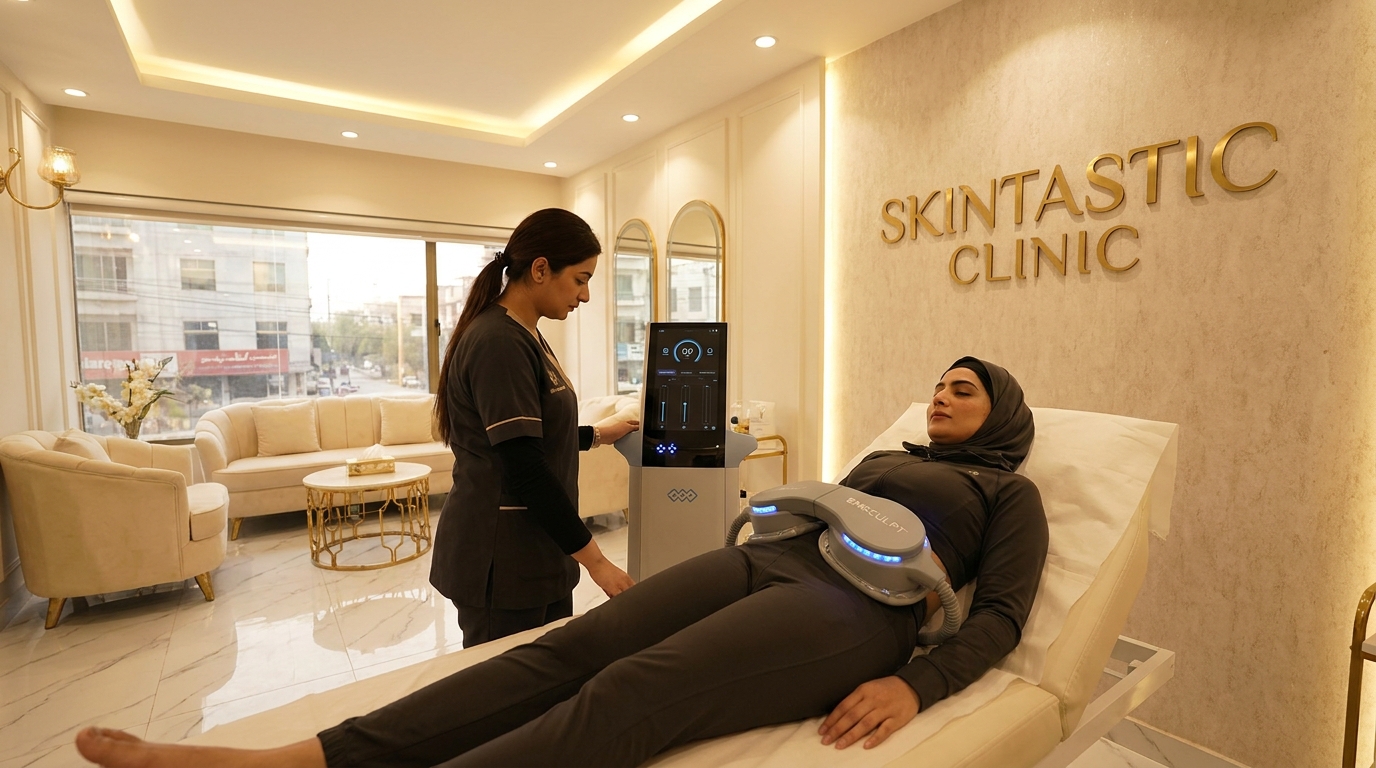
EMSculpt delivers faster, targeted muscle-building and fat-reduction results compared to traditional workouts by inducing 20,000 supramaximal contractions in a single 30-minute session. While a standard resistance training regimen requires three to six months of consistent progressive overload to yield visible hypertrophy and fat loss, high-intensity focused electromagnetic (HIFEM) technology stimulates deep muscle remodeling within just two to four weeks. Traditional exercise relies on voluntary central nervous system recruitment, which caps muscle fiber engagement at approximately 30 to 40 percent of total capacity. In contrast, HIFEM bypasses central nervous system limitations, forcing near 100 percent muscle fiber engagement in the targeted area. This profound physiological stress triggers rapid cellular adaptation, resulting in an accelerated timeline for achieving localized body contouring goals. Modern aesthetic medicine utilizes this mechanism to help patients achieve distinct abdominal definition, gluteal lifting, and targeted extremity toning safely and efficiently.
Key Takeaways:
- EMSculpt produces visible muscle definition and fat reduction within 2 to 4 weeks, significantly faster than traditional gym workouts.
- A single 30-minute EMSculpt session induces approximately 20,000 supramaximal muscle contractions, an intensity impossible to achieve through voluntary exercise.
- EMSculpt is a localized body contouring treatment that complements, rather than replaces, cardiovascular training and overall fitness routines.
EMSculpt vs Traditional Workout: Which Gives Faster Results?
1. How Quickly Does EMSculpt Produce Results Compared to Gym Workouts?
Patients typically see visible EMSculpt results within two to four weeks after completing a standard four-session protocol, whereas traditional gym workouts require 12 to 24 weeks of consistent effort for similar localized changes. The standard clinical protocol for EMSculpt involves four 30-minute sessions spaced two to three days apart. During this intensive two-week period, the targeted muscles undergo extreme stress, forcing them to adapt by increasing myofibrillar volume (hypertrophy) and creating new protein strands and muscle fibers (hyperplasia). Consequently, the muscle tissue thickens and strengthens at a highly accelerated rate. Peak clinical results are most frequently documented at the six-week mark post-treatment. Traditional strength training, conversely, operates on the principle of micro-tears and gradual recovery. Human physiology dictates that natural muscle synthesis through voluntary exercise is a prolonged process, requiring months of optimized nutrition, adequate recovery, and consistent mechanical tension. According to clinical studies on HIFEM technology, the rapid timeline of electromagnetic contouring is a direct result of the continuous, unyielding contraction rate that condenses months of mechanical stress into a fraction of the time.
2. Understanding the Core Differences in Muscle Contraction Mechanics
EMSculpt generates supramaximal contractions that engage 100 percent of the muscle fibers in the treatment area, while traditional workouts rely on voluntary contractions that engage only 30 to 40 percent of muscle fibers at any given time. The fundamental disparity between these two modalities lies in neurological limitations. When a person performs a sit-up or a squat, the brain sends an electrical signal to the motor neurons. To prevent muscle tearing and tendon avulsion, the human nervous system naturally inhibits maximum force output. This protective mechanism ensures that muscles operate well below their absolute threshold. EMSculpt completely circumvents this biological safeguard. By directing focused electromagnetic energy entirely through the skin and fat directly into the motor neurons, the device forces the muscle to contract at its absolute physical maximum. Because these contractions do not rely on conscious effort or nervous system pacing, the muscle is forced into an extreme state of adaptation. This extreme adaptation phase is what makes body contouring therapy highly effective for patients seeking accelerated local muscle enhancement.
The Role of Lactic Acid and Recovery Timelines
A major limiting factor in traditional exercise is the buildup of lactic acid, which causes severe muscle fatigue and delayed onset muscle soreness (DOMS). When a person performs intense voluntary exercise, lactic acid accumulation forces them to stop the set and rest for several minutes. Furthermore, DOMS requires 48 to 72 hours of recovery before the same muscle group can be trained again effectively. EMSculpt devices incorporate specific therapeutic resting phases within the 30-minute program. These rhythmic tapping phases are specifically designed to flush lactic acid from the treated muscle tissue immediately. As a result, patients experience intense muscle fatigue during the session but rarely suffer from debilitating DOMS afterward, allowing them to resume normal daily activities without a mandatory multi-day recovery period.
3. Targeted Fat Reduction and Adipocyte Apoptosis
EMSculpt can reduce localized subcutaneous fat by an average of 19 percent in the treated area by triggering fat cell apoptosis, while traditional exercise primarily burns systemic fat evenly over an extended period. Spot reduction—the concept of losing fat in one specific area by exercising that area—is biologically impossible through traditional workouts. When a person performs abdominal crunches, the body burns calories globally, utilizing fat stores from genetically predetermined areas rather than specifically from the abdomen. EMSculpt alters this dynamic through localized hypermetabolism. The 20,000 supramaximal contractions demand an immense amount of localized energy. To meet this immediate energy requirement, the surrounding fat cells are forced into extreme lipolysis, releasing free fatty acids at a rate that overwhelms the adipocytes. This toxic accumulation of free fatty acids causes the fat cells to undergo apoptosis (programmed cell death). Over the following weeks, the lymphatic system naturally metabolizes and clears these dead fat cells from the body permanently. Patients seeking localized fat reduction often explore EMSculpting treatment in Sargodha to address stubborn fat deposits that remain resistant to general cardiovascular exercise.
4. Time Commitment and Session Duration Comparison
A full EMSculpt protocol requires exactly two hours of total clinical time over two weeks, whereas generating similar muscle growth in a gym requires 36 to 48 hours of active training over three months. The efficiency of non-invasive body contouring is one of its primary clinical advantages. Professional and aesthetic time constraints often prevent individuals from maintaining the rigorous five-day-a-week training schedules necessary for significant body recomposition. Evaluating the precise metrics provides a clear perspective on the efficiency variance between the two methods.
| Metric | EMSculpt Protocol | Traditional Workout Regimen |
|---|---|---|
| Session Duration | 30 minutes per session | 60 to 90 minutes per session |
| Frequency | 4 sessions total (over 2 weeks) | 3 to 5 sessions weekly (ongoing) |
| Contraction Volume | 20,000 per 30 minutes | 300 to 500 per session |
| Muscle Engagement | Approximately 100% capacity | 30% to 40% capacity |
| Fat Reduction Focus | Highly localized (site-specific) | Systemic (full-body distributed) |
| Initial Results Onset | 2 to 4 weeks | 12 to 16 weeks |
5. Can EMSculpt Replace a Traditional Workout Routine?
No, EMSculpt cannot replace a traditional workout routine because it does not provide cardiovascular conditioning, improve joint mobility, or enhance overall systemic cardiovascular health. While HIFEM technology is superior for rapid, localized muscle hypertrophy and site-specific fat apoptosis, human health requires a multi-faceted approach. Cardiovascular exercise, such as running, swimming, or cycling, strengthens the heart muscle, lowers resting blood pressure, improves lung capacity, and regulates blood glucose levels. EMSculpt does not elevate the heart rate sufficiently to deliver these essential systemic benefits. Furthermore, traditional weightlifting builds bone density through axial loading and improves ligament and tendon strength, elements crucial for long-term orthopedic health. Medical aesthetic professionals strictly advise using electromagnetic contouring as a powerful supplement to, rather than a substitute for, an active lifestyle. Patients achieve the most sustainable aesthetic and health outcomes when they combine targeted electromagnetic muscle stimulation with healthy weight loss approaches that include balanced nutrition and regular cardiovascular activity.
6. Ideal Candidates for Non-Surgical Body Sculpting
The ideal candidate for EMSculpt is an individual with a Body Mass Index (BMI) under 30 who maintains a relatively healthy lifestyle but struggles with stubborn fat pockets or lacks localized muscle definition. EMSculpt is officially classified as a body contouring procedure, not a weight-loss treatment. Patients carrying significant amounts of visceral fat—the hard fat stored deep within the abdominal cavity behind the muscle wall—will not see optimal results, as the electromagnetic waves primarily target the muscle layer and the subcutaneous fat residing directly beneath the skin. According to guidelines from the American Society of Plastic Surgeons, non-surgical fat reduction technologies yield the highest patient satisfaction rates when utilized by individuals near their target body weight. Patients in Sargodha visiting aesthetic clinics are thoroughly assessed for sub-dermal fat thickness and muscle tone baseline prior to commencing the protocol. For individuals focused on diastasis recti (abdominal muscle separation commonly occurring post-pregnancy), EMSculpt serves as an exceptional rehabilitative tool, physically pulling the separated muscle walls back together by an average of 11 percent.
Maintenance and Long-Term Durability
The fat cells destroyed during an EMSculpt session are permanently removed from the body and cannot regenerate. However, the remaining fat cells in the untreated areas, and the localized area itself, can still expand if a patient consumes a severe caloric surplus. The muscle mass generated by HIFEM technology behaves identically to naturally acquired muscle mass. If a patient remains completely sedentary post-treatment, muscle atrophy will slowly occur over six to twelve months. To maintain peak definition, aesthetic physicians recommend a single follow-up EMSculpt maintenance session every three to six months, paired with adequate dietary protein intake and routine physical activity. This protocol ensures the structural integrity of the newly formed myofibrils remains robust and visually distinct.
Conclusion
Determining whether EMSculpt or traditional workouts provide faster results depends entirely on the specific anatomical goals of the patient. For localized muscle hypertrophy, core strengthening, and targeted subcutaneous fat reduction, EMSculpt delivers measurable results significantly faster than conventional resistance training by leveraging involuntary supramaximal contractions. By achieving in two weeks what would mathematically take months of rigorous gym training, electromagnetic contouring serves as a highly efficient aesthetic and physical enhancement tool. However, optimizing total body wellness dictates that EMSculpt should be integrated into a broader lifestyle strategy encompassing standard exercise and proper nutrition for comprehensive physiological health.
Frequently Asked Questions
Does EMSculpt give faster results than a traditional gym workout?
Yes, EMSculpt yields visible muscle definition and fat reduction within two to four weeks, whereas traditional gym workouts typically require three to six months to produce similar localized results.
Is EMSculpt safe for building muscle without causing joint strain?
Yes, EMSculpt safely bypasses the joints and tendons by using electromagnetic energy to directly stimulate motor neurons, eliminating the mechanical joint stress associated with heavy weightlifting.
Can EMSculpt completely replace my cardiovascular exercise routine?
No, EMSculpt cannot replace cardiovascular exercise because it does not elevate the heart rate or provide the systemic benefits necessary for long-term heart and lung health.
Does the fat reduction achieved through EMSculpt last permanently?
Yes, the fat cells destroyed during the EMSculpt process undergo apoptosis and are permanently eliminated from the body, provided the patient maintains a stable weight.
Is the EMSculpt treatment painful compared to extreme weightlifting?
No, EMSculpt is not typically considered painful; patients commonly report a sensation of intense muscle contractions similar to a rigorous workout, but without the debilitating delayed onset muscle soreness (DOMS) that follows extreme weightlifting.